Table of Contents
- Introduction
- What Is Face Mapping?
- What Your Breakouts Could Be Telling You
- Forehead & hairline
- Cheeks and jawline
- Nose and T-zone
- Chin and neck
- How to Respond: Skincare & Lifestyle
- Product Recommendations
- Conclusion
Introduction
Have you ever wondered why a stubborn breakout keeps appearing in the same spot on your face? I certainly have — and as a beauty-obsessed person (and someone who runs this skincare site), I’ve come to realise that your skin is speaking to you. In this post we’re going to explore what the ancient concept of face mapping actually is, what those breakouts might be signalling about your internal health or lifestyle, and – most importantly – how you can respond with smart choices. If you’ve already read our post “Behind the Label: Understanding Clean Beauty and What It Really Means for Your Skin and Hair”, you’ll see how internal and external health really tie together.
What Is Face Mapping?
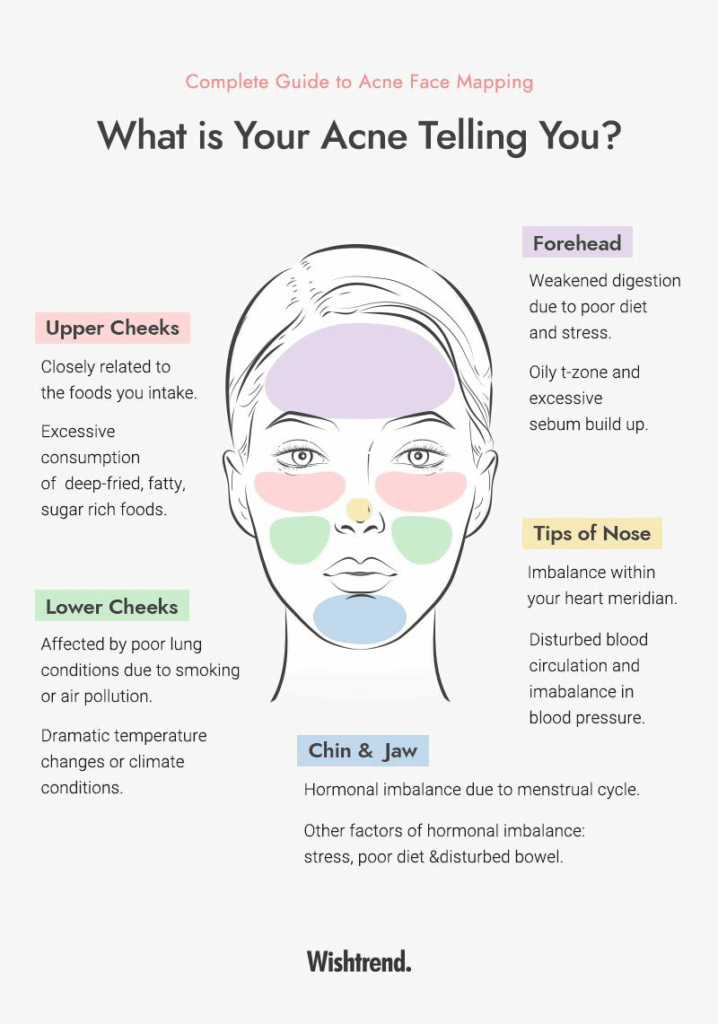
Face mapping is a method (derived from ancient Chinese medicine and Ayurveda) that associates breakout locations on the face with possible underlying causes: such as digestion, hormones, stress or diet. The idea is that different zones correspond to organs or systems — so the skin is acting like a mirror of your internal health.
This doesn’t mean every single blemish has a mystical meaning — but it does prompt you to look deeper than just “apply a spot cream”.
What Your Breakouts Could Be Telling You
Forehead & hairline
Breakouts across the forehead, along the hairline or temples may point to issues like poor sleep, digestive strain, too much caffeine, or hair products transferring oils to the skin.
Cheeks and jawline
These zones are often tied to hormones (especially the jawline), or maybe diet (like dairy or sugar), or even a dirty phone or pillowcase that’s contacting the skin surface.
Nose and T-zone
Frequent breakouts around the nose, between the brows or on the centre of the face may suggest oily skin, excess sebum, stress responses, or even elevated blood pressure / poor circulation in some theories.
Chin and neck
This area is strongly linked to hormonal imbalance (think menstrual cycle, PCOS, menopause) but could also be due to stress, digestive issues, or the way you sleep (e.g. hands under the chin).
How to Respond: Skincare & Lifestyle
When you spot a breakout repeatedly in a zone, it’s useful to:
- Review your lifestyle (sleep, water intake, stress levels, diet, hair/skin product hygiene).
- Match your skincare accordingly: gentle cleansing, non-comedogenic formulas, targeted spot treatments.
- Consider linking this to other areas of your holistic routine — you might also benefit from the layering techniques in “How to Layer Your Skincare Products Like a Pro”.
- Keep track of patterns (e.g., does that chin breakout always coincide with your cycle?).
Product Recommendations
Here are three solid Amazon UK-available products to help support the skin in breakout-prone zones.
- Amazon UK Product: Gentle Foaming Cleanser for oily / breakout-prone skin – great for the T-zone and forehead.
- Amazon UK Product: Non-comedogenic Spot Treatment Gel – ideal for jawline and chin breakouts.
- Amazon UK Product: Lightweight Oil-Free Moisturiser with Niacinamide – to support skin barrier without clogging.

Conclusion
Breakouts are more than just a nuisance — they can be a signal, a message from your skin about what’s going on internally or externally. By using face mapping as a tool, you can decode patterns, respond with intention, and create a routine that supports your skin, health and lifestyle together. And if you want to build that full routine, check out our subsequent blog “How to Layer Your Skincare Products Like a Pro”. Your skin deserves informed care — not just reactive patching.